
| Navigation |
|
Search: Screenshots: 


|
Hello World
Welcome to the ODIN homepage! ODIN is a C++ software framework to
develop and simulate magnetic resonance sequences.
It is
Some Highlights of ODIN
ODIN Components
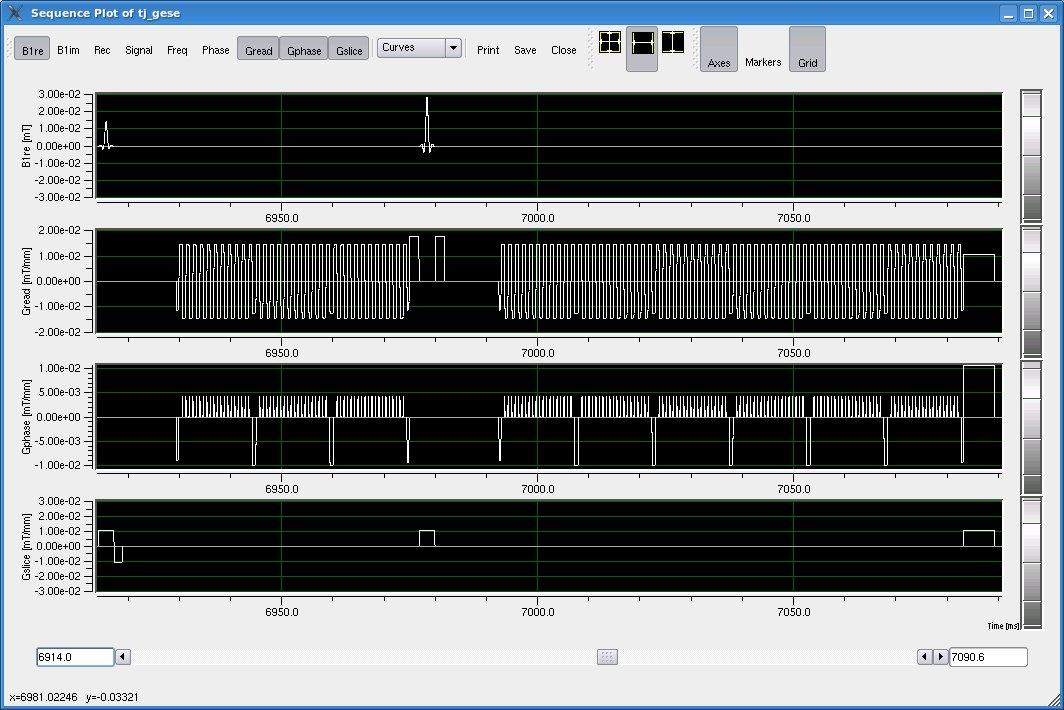
Odin [Screenshot] [Screenshot]
The control center for developing, testing, visualizing and
simulating NMR sequences. It is a front-end to the ODIN libraries,
allowing interactive editing, recompiling and dynamic linking
of sequence modules.
Pulsar [Screenshot]
A graphical user interface for the generation and simulation of RF pulses
is provided by the Pulsar program. Parameters of the pulse can be edited
interactively and the corresponding excitation profile is displayed
simultaneously. A modular approach is used for maximum flexibility:
The pulse shape, k-space trajectory and filter function of the pulse are
generated by independent functions. They can be combined in many ways,
e.g. a box-shaped pulse can be generated using any of the spiral trajectories
and any of the filter functions.
The functions of the pulse are implemented using a plug-in mechanism
(abstract C++ base classes where the functions are implemented in the
derived classes).
Thus new pulse shapes, trajectories and filter functions can be added easily by
defining new function classes.
MiView [Screenshot]
A command line driven data viewer that supports the following formats:
Display properties (contrast, brightness) can be adjusted. The value of regions and single points can be retrieved and scan-line profiles can be generated interactively.
Geoedit [Screenshot]
A lightweight geometry editor that exports the selected geometry parameters
to the ODIN sequence development framework.
Many Useful Command-Line Utilities
The main functionality of ODIN can be found in a couple of libraries:
tjutils
This library contains various helper classes and functions that are
not specific to MR.
odinpara
Library to handle MR parameters, such as system properties, scan geometry,
sequence parameters. Input/output of parameters is achieved via JCAMP-DX file
format.
odinseq
This library contains the interface for sequence programming. It also contains
the hardware specific driver routines.
odindata
The Blitz++ library is used for handling multidimensional arrays in ODIN.
In addition, many MR-specific routines (FFT, phase correction) were added
and placed in this library.
| Contact |
| If you have any questions, bug-reports or improvements, if you need professional support with ODIN, or if you know how to make a better web page than this, please do not hesitate to contact me (Thies Jochimsen). |
| Licensing |
| ODIN is published under the terms of the GNU General Public License. |
| Disclaimer |
| ODIN is a framework for research purposes only. It is not certified for clinical use. Hence, it cannot replace approved solutions from commercial manufacturers. |